North Idaho Firearms

Pistol

BEGINNER PISTOL FUNDAMENTALS

Course Length: 6 Hours
Format: Classroom Only – No Live Fire / No Range Time
Experience Level: Beginner
Cost: $40 Cash / $45 Card

COURSE PURPOSE

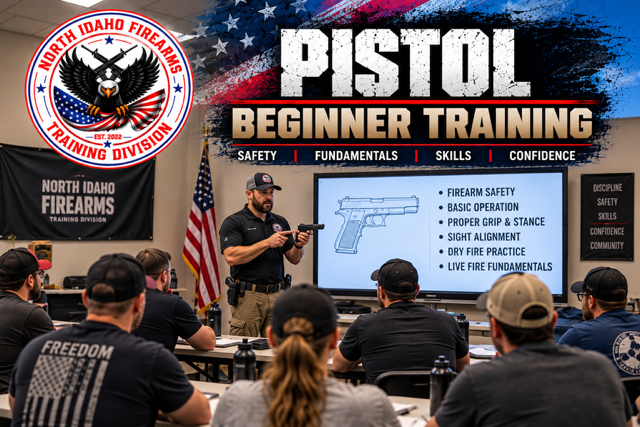
Beginner Pistol Fundamentals is designed for new and inexperienced handgun owners who want to develop a solid understanding of pistol safety, operation, equipment and basic shooting fundamentals before progressing to live-fire training.

Students will learn the differences between semi-automatic pistols and revolvers, how common handgun systems operate, ammunition and magazine fundamentals, sighting systems, safe handling, basic shooting fundamentals, range etiquette, and routine pistol maintenance.

REQUIRED EQUIPMENT

  • Pistol – semi-automatic or revolver
  • Empty magazine for semi-automatic pistols
  • Pistol case

PISTOL LEVEL 1 – FUNDAMENTALS LIVE FIRE

Course Length: 4–5 Hours
Format: 100% Range / Live Fire
Experience Level: Beginner
Prerequisite: Beginner Pistol Fundamentals or Instructor Approval
Ammunition: 250–300 Rounds

COURSE DESCRIPTION

Pistol Level 1 is the first live-fire course in the North Idaho Firearms pistol training progression. It builds directly upon the safety, firearm operation and shooting fundamentals introduced during Beginner Pistol Fundamentals.

Students transition those classroom concepts to the firing line with an emphasis on safe firearm handling, accuracy, consistency and development of strong shooting fundamentals.

This course establishes the live-fire foundation students will need before progressing to the increased pistol manipulation and holster work of Pistol Level 2.

REQUIRED EQUIPME…
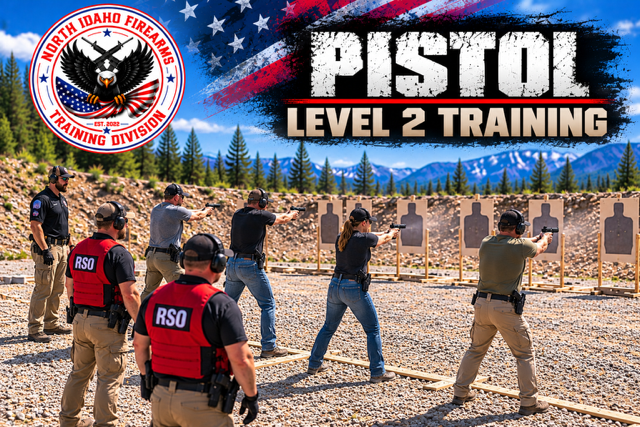
PISTOL LEVEL 2

Course Length: 4–6 Hours
Format: 100% Range / Live Fire
Experience Level: Beginner to Intermediate
Prerequisite: Beginner Pistol Fundamentals or Instructor Approval
Ammunition: 350 Rounds Minimum

COURSE DESCRIPTION

Pistol Level 2 is a live-fire training course designed to build upon the knowledge and fundamentals taught in Beginner Pistol Fundamentals.

Students begin with range safety, firearm handling and basic marksmanship before progressing into practical pistol manipulation. Training includes stance, grip, sighting systems, recoil management, holster fundamentals, magazine changes, malfunction clearing, multiple distances and controlled multiple-round exercises.

The emphasis throughout the course is safety, accuracy, consistency and proper firearm handling.

REQUIRED EQUIPMENT

  • Semi-automatic pistol….

PISTOL LEVEL 3 – ADVANCED LIVE FIRE

Course Length: 5–6 Hours
Format: 100% Range / Live Fire
Experience Level: Advanced
Prerequisite: Pistol Level 2 or Instructor Approval
Ammunition: 450–500 Rounds

COURSE DESCRIPTION

Pistol Level 3 is the advanced course in the North Idaho Firearms pistol training progression. It builds directly upon the safety, marksmanship, pistol manipulation and holster skills developed during Beginner Pistol Fundamentals and Pistol Levels 1 and 2.

Students begin by confirming previously learned fundamentals before progressing into exercises that integrate pistol presentation, recoil management, reloads, malfunction response, multiple shooting positions, multiple distances, target transitions and controlled movement.

The emphasis throughout Level 3 is maintaining safe firearm handling, accuracy, consistency and sound fundamentals while performing increasingly challenging live-fire exercises….

BEGINNER PISTOL FUNDAMENTALS

Course Length: 6 Hours
Format: Classroom Only – No Live Fire / No Range Time
Experience Level: Beginner
Cost: $40 Cash / $45 Card

COURSE PURPOSE

Beginner Pistol Fundamentals is designed for new and inexperienced handgun owners who want to develop a solid understanding of pistol safety, operation, equipment and basic shooting fundamentals before progressing to live-fire training.

Students will learn the differences between semi-automatic pistols and revolvers, how common handgun systems operate, ammunition and magazine fundamentals, sighting systems, safe handling, basic shooting fundamentals, range etiquette, and routine pistol maintenance.

REQUIRED EQUIPMENT

  • Pistol – semi-automatic or revolver
    • Empty magazine for semi-automatic pistols
    • Pistol case
    • Optic / red-dot sight if equipped or available
    • Red dot recommended for students selecting an optic
    • Iron sights as equipped
    • Owner’s manual if available
    • Notebook and pen recommended

NO LIVE AMMUNITION IN THE CLASSROOM

COURSE TOPICS

Firearm Safety & Responsible Handling

  • Fundamental firearm safety rules
  • Muzzle awareness and muzzle control
  • Trigger-finger discipline
  • Safe handling and storage
  • Verifying that a pistol is unloaded
  • Safe classroom handling procedures

Understanding the Pistol

  • Major handgun components
  • Semi-automatic pistol operation
  • Revolver operation
  • Differences between semi-automatics and revolvers
  • Common handgun controls
  • Basic cycle of operation
  • Safely opening and inspecting the action

Ammunition & Magazines

  • Basic handgun ammunition components
  • Common handgun calibers
  • Understanding caliber markings
  • Selecting the correct ammunition for the firearm
  • Semi-automatic magazines
  • Magazine construction and function
  • Revolver cylinders and ammunition capacity
  • Ammunition inspection and safe storage

Sights & Target Acquisition

  • Iron sights
  • Red-dot optics
  • Sight alignment
  • Sight picture
  • Target acquisition
  • Proper visual focus
  • Advantages and limitations of common sighting systems

Pistol Shooting Fundamentals

  • Proper stance and balance
  • Two-handed grip
  • Consistent pistol presentation
  • Target acquisition
  • Trigger-finger placement
  • Trigger control
  • Follow-through
  • Muzzle control

Range Etiquette

  • Understanding the firing line
  • Common range commands
  • When firearms may be handled
  • Safe direction and muzzle awareness
  • Communication with instructors and Range Safety Officers
  • What to expect during a live-fire training class

Field Stripping, Cleaning & Maintenance

  • Preparing the pistol for maintenance
  • Confirming the firearm is unloaded
  • Basic field stripping
  • Identifying major components
  • Cleaning the barrel and action
  • Inspection for excessive wear or damage
  • Proper lubrication
  • Reassembly
  • Function checks according to the manufacturer’s instructions
  • Routine maintenance and storage

SUGGESTED 6-HOUR COURSE STRUCTURE

Hour 1 – Safety & Pistol Familiarization
Firearm safety, responsible handling, semi-automatic and revolver components, controls and basic operation.

Hour 2 – Ammunition & Feeding Systems
Ammunition fundamentals, caliber identification, magazines, revolver cylinders and ammunition compatibility.

Hour 3 – Sights & Shooting Fundamentals
Iron sights, red-dot optics, sight alignment, sight picture, stance, grip and target acquisition.

Hour 4 – Trigger & Pistol Control
Trigger control, presentation, muzzle control, follow-through and supervised unloaded practical handling.

Hour 5 – Range Preparation & Etiquette
Range commands, firing-line procedures, Range Safety Officer interaction and preparing students for their first live-fire course.

Hour 6 – Field Strip, Cleaning & Review
Field stripping, inspection, cleaning, lubrication, reassembly, maintenance and final course review.

COURSE GOAL

Upon completion, students should have the knowledge necessary to safely handle and maintain their pistol, understand its basic operation and equipment, demonstrate the fundamental concepts of stance, grip, sighting and trigger control, and understand proper range procedures before progressing to live-fire pistol training.

Recommended Next Course: Pistol Level 1 – Live Fire

PISTOL LEVEL 1 – FUNDAMENTALS LIVE FIRE

Course Length: 4–5 Hours
Format: 100% Range / Live Fire
Experience Level: Beginner
Prerequisite: Beginner Pistol Fundamentals or Instructor Approval
Ammunition: 250–300 Rounds

COURSE DESCRIPTION

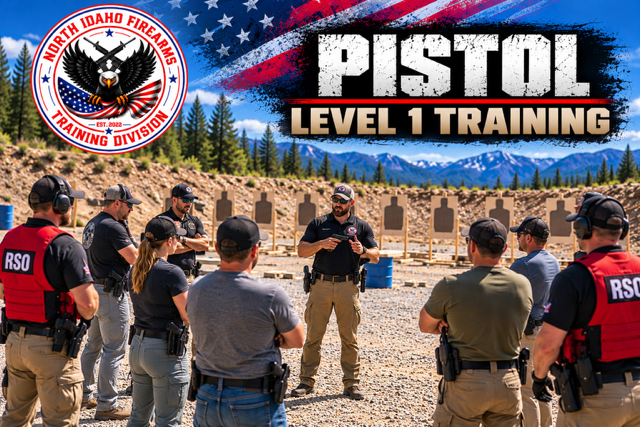
Pistol Level 1 is the first live-fire course in the North Idaho Firearms pistol training progression. It builds directly upon the safety, firearm operation and shooting fundamentals introduced during Beginner Pistol Fundamentals.

Students transition those classroom concepts to the firing line with an emphasis on safe firearm handling, accuracy, consistency and development of strong shooting fundamentals.

This course establishes the live-fire foundation students will need before progressing to the increased pistol manipulation and holster work of Pistol Level 2.

REQUIRED EQUIPMENT

  • Semi-automatic pistol
    • 250–300 rounds of appropriate ammunition
    • Minimum 2–3 magazines
    • Pistol case
    • Range bag
    • Eye protection
    • Ear protection
    • Red-dot optic or iron sights
    • Appropriate clothing for weather conditions
    • Closed-toe shoes or boots
    • Ballcap recommended
    • Water / hydration
    • Snacks
    • Cleaning kit / basic tools recommended

Holster equipment is not required for Level 1.

SAFETY & RANGE PROCEDURES

  • Firearm safety rules
    • Range commands
    • Firing-line procedures
    • Muzzle awareness and control
    • Trigger-finger discipline
    • Safe loading and unloading
    • Safe magazine insertion and removal
    • Chamber verification
    • Safe handling between shooting exercises

LEVEL 1 SHOOTING FUNDAMENTALS

  • Proper shooting stance and balance
    • Establishing a consistent two-handed grip
    • Grip pressure and pistol control
    • Proper pistol presentation
    • Iron-sight alignment and sight picture
    • Red-dot acquisition and presentation
    • Target acquisition
    • Trigger-finger placement
    • Trigger control
    • Follow-through
    • Recoil management
    • Re-establishing sights after recoil
    • Maintaining accuracy during multiple-shot strings

LIVE-FIRE SKILLS

Students progressively apply the fundamentals through:

  • Single-round accuracy exercises
    • Controlled multiple-round strings
    • Consistent presentation to the target
    • Sight confirmation before firing
    • Trigger-control exercises
    • Recoil-management exercises
    • Shooting at multiple practical distances
    • Accuracy from different distances
    • Magazine loading and firearm loading procedures
    • Safe unloading and clearing procedures
    • Basic magazine changes from a controlled firing-line position
    • Target acquisition and reacquisition
    • Introduction to shooting cadence
    • Final fundamentals evaluation

4–5 HOUR RANGE STRUCTURE

Block 1 – Safety & First Live Fire
Range briefing, firearm inspection, loading/unloading procedures, range commands and initial accuracy exercises.

Block 2 – Stance, Grip & Trigger Control
Developing a repeatable shooting position, grip, trigger press, follow-through and basic recoil management.

Block 3 – Sights & Target Acquisition
Iron sights and red-dot application, pistol presentation, sight confirmation and target acquisition.

Block 4 – Multiple Rounds & Distances
Controlled multiple-round strings, recoil recovery, shooting cadence and applying fundamentals at different distances.

Block 5 – Skills Integration & Evaluation
Live-fire exercises combining stance, grip, sights, trigger control, recoil management, loading/unloading and consistent accuracy.

COURSE GOAL

Upon completion, students should be able to safely operate their pistol on a live-fire range and demonstrate consistent application of stance, grip, sights, target acquisition, trigger control, recoil management and basic pistol manipulation.

The student should leave Level 1 with a solid live-fire foundation before progressing into holster work, reloads, malfunction clearing, multiple targets and more complex shooting exercises.

Next Course: Pistol Level 2

North Idaho Firearms – Training Division

PISTOL LEVEL 2

Course Length: 4–6 Hours
Format: 100% Range / Live Fire
Experience Level: Beginner to Intermediate
Prerequisite: Beginner Pistol Fundamentals or Instructor Approval
Ammunition: 350 Rounds Minimum

COURSE DESCRIPTION

Pistol Level 2 is a live-fire training course designed to build upon the knowledge and fundamentals taught in Beginner Pistol Fundamentals.

Students begin with range safety, firearm handling and basic marksmanship before progressing into practical pistol manipulation. Training includes stance, grip, sighting systems, recoil management, holster fundamentals, magazine changes, malfunction clearing, multiple distances and controlled multiple-round exercises.

The emphasis throughout the course is safety, accuracy, consistency and proper firearm handling.

REQUIRED EQUIPMENT

  • Semi-automatic pistol
    • 350 rounds of appropriate ammunition
    • Eye protection
    • Ear protection
    • Range bag
    • Sturdy belt
    • Properly fitted pistol holster
    • Minimum 3 magazines recommended
    • Magazine pouches
    • Pistol case
    • Red-dot optic or iron sights
    • Appropriate clothing for weather conditions
    • Closed-toe shoes or boots
    • Ballcap recommended
    • Water / hydration
    • Snacks
    • Basic cleaning kit / tools recommended

SAFETY & FUNDAMENTALS REVIEW

Training begins by reinforcing the fundamentals introduced in the Beginner Pistol course:

  • Firearm safety rules
    • Range commands and procedures
    • Muzzle awareness and control
    • Trigger-finger discipline
    • Safe loading and unloading
    • Stance and balance
    • Proper two-handed grip
    • Sight alignment / sight picture
    • Red-dot fundamentals
    • Target acquisition
    • Trigger control and follow-through

LEVEL 2 LIVE-FIRE SKILLS

Students progress through:

  • Basic live-fire marksmanship
    • Consistent pistol presentation
    • Recoil management and recovery
    • Shooting controlled multiple-round strings
    • Shooting from multiple distances
    • Red-dot or iron-sight application
    • Holster safety and fundamentals
    • Safe draw and presentation
    • Safe re-holstering procedures
    • Emergency / slide-lock magazine changes
    • Tactical magazine changes
    • Recognizing common pistol malfunctions
    • Safe malfunction-clearing procedures
    • Target transitions
    • Introduction to multiple-target exercises
    • Combining previously learned skills into live-fire evolutions

4–6 HOUR RANGE STRUCTURE

Block 1 – Safety & Fundamentals
Range briefing, firearm inspection, loading/unloading procedures, stance, grip, sights, trigger control and basic live-fire accuracy.

Block 2 – Marksmanship & Recoil Management
Live fire from multiple distances, target acquisition, recoil recovery, controlled pairs and multiple-round strings.

Block 3 – Holster Fundamentals
Safe holster use, drawing and presenting the pistol, establishing the shooting grip and controlled live-fire application.

Block 4 – Magazine Changes & Malfunctions
Emergency/slide-lock reloads, tactical magazine changes, recognition of common stoppages and safe malfunction clearing.

Block 5 – Multiple Distances & Targets
Applying fundamentals as distance changes, target transitions and introductory multiple-target exercises.

Block 6 – Skills Integration & Evaluation
Progressive live-fire exercises combining safe pistol handling, presentation, accuracy, reloads, malfunction response and previously learned Level 2 skills.

COURSE GOAL

Upon completion, students should demonstrate safe and consistent pistol handling during live fire and be able to apply the fundamentals learned in the Beginner Pistol course while working with a holster, performing magazine changes, responding to common malfunctions and engaging targets from multiple distances.

Successful completion prepares the student for Pistol Level 3 – Advanced Live Fire.

PISTOL LEVEL 3 – ADVANCED LIVE FIRE

Course Length: 5–6 Hours
Format: 100% Range / Live Fire
Experience Level: Advanced
Prerequisite: Pistol Level 2 or Instructor Approval
Ammunition: 450–500 Rounds

COURSE DESCRIPTION

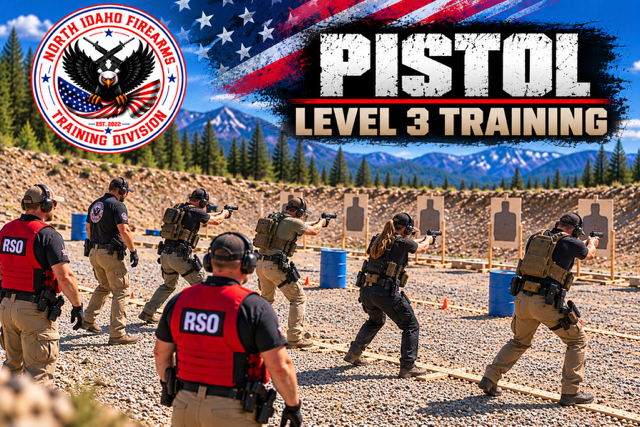
Pistol Level 3 is the advanced course in the North Idaho Firearms pistol training progression. It builds directly upon the safety, marksmanship, pistol manipulation and holster skills developed during Beginner Pistol Fundamentals and Pistol Levels 1 and 2.

Students begin by confirming previously learned fundamentals before progressing into exercises that integrate pistol presentation, recoil management, reloads, malfunction response, multiple shooting positions, multiple distances, target transitions and controlled movement.

The emphasis throughout Level 3 is maintaining safe firearm handling, accuracy, consistency and sound fundamentals while performing increasingly challenging live-fire exercises.

REQUIRED EQUIPMENT

• Semi-automatic pistol
• 450–500 rounds of appropriate ammunition
• Eye protection
• Ear protection
• Range bag
• Sturdy belt
• Properly fitted holster
• Minimum 3–4 magazines
• Magazine pouches
• Pistol case
• Red-dot optic or iron sights
• Appropriate clothing for weather conditions
• Closed-toe shoes or boots
• Ballcap recommended
• Water / hydration
• Snacks
• Knee pads recommended
• Cleaning kit / basic tools recommended

LEVEL 1 & 2 SKILLS CONFIRMATION

Students begin by confirming proficiency with previously learned skills:

• Firearm and range safety
• Stance and two-handed grip
• Pistol presentation
• Iron sights / red-dot acquisition
• Trigger control and follow-through
• Recoil management
• Safe holster draw and presentation
• Safe re-holstering
• Emergency / slide-lock reloads
• Tactical magazine changes
• Malfunction recognition and clearing
• Multiple-round strings
• Multiple distances
• Target transitions
• Multiple-target fundamentals

LEVEL 3 SKILLS

Training progresses into:

• Advanced pistol presentation
• Maintaining accuracy at increased shooting tempo
• Rapid target acquisition and reacquisition
• Multiple-target transitions
• Shooting from varying distances
• Shooting from standing and kneeling positions
• Controlled transitions between shooting positions
• Reloads incorporated into live-fire exercises
• Malfunction response incorporated into exercises
• Controlled movement into and out of shooting positions
• Introduction to use of cover / barricades
• Shooting from around cover when appropriate
• Equipment management during complex exercises
• Combining multiple previously learned skills
• Advanced multiple-round evolutions
• Final integrated skills evaluation

5–6 HOUR RANGE STRUCTURE

Block 1 – Safety & Skills Confirmation
Range briefing, firearm inspection and confirmation of Level 1 and Level 2 fundamentals including accuracy, pistol presentation, recoil management, reloads and safe holster work.

Block 2 – Advanced Manipulation
Pistol presentation, target acquisition, multiple-round strings, reloads and malfunction response incorporated into progressive live-fire exercises.

Block 3 – Multiple Targets & Distances
Target transitions, changing distances, accuracy standards and maintaining fundamentals as shooting tempo increases.

Block 4 – Positions & Controlled Movement
Standing and kneeling positions, controlled position changes and movement into and out of designated shooting positions.

Block 5 – Cover & Integrated Skills
Introduction to cover/barricades and exercises combining pistol presentation, multiple targets, reloads, malfunction response and position changes.

Block 6 – Advanced Skills Evaluation
Final progressive exercises combining previously learned skills. Students are evaluated on safety, accuracy, firearm handling, consistency and application of course fundamentals.

COURSE GOAL

Upon completion, students should demonstrate safe and consistent advanced pistol handling while integrating the skills developed throughout the NIFT pistol training progression.

Students should be capable of maintaining acceptable accuracy and safe firearm handling while incorporating holster work, multiple targets, changing distances, reloads, malfunction response, different shooting positions and controlled movement.