North Idaho Firearms

Tactical Rifle Training
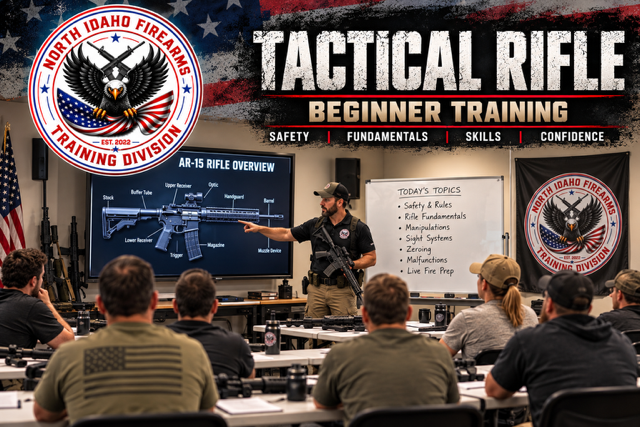
TACTICAL RIFLE BEGINNER FUNDAMENTALS

Course Length: 6 Hours
Format: Classroom Only – No Live Fire / No Range Time
Experience Level: Beginner
Course Fee: $40 Cash / $45 Card

COURSE DESCRIPTION

The Beginner AR-15 Fundamentals Course is designed for new or inexperienced AR-15 owners who want to develop a solid understanding of their rifle before attending live-fire training.

This six-hour classroom course introduces students to the AR-15 platform with an emphasis on firearm safety, responsible handling, basic operation, equipment selection, shooting fundamentals, range etiquette, and routine maintenance.

Students will use their own unloaded AR-15 during supervised classroom demonstrations and practical exercises. No live ammunition will be permitted in the classroom.

REQUIRED EQUIPMENT

Students should bring….
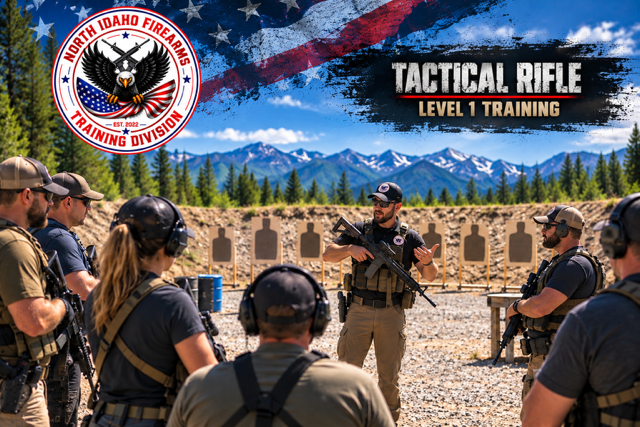
Tactical Rifle Level 1

Course Length: 5 Hours
Format: Range / Live-Fire Training
Ammunition: 350 rounds minimum — .223 Remington / 5.56×45mm

Course Description: AR-15 Level 1 is designed for shooters who understand the basic operation of their rifle and are ready to develop safe, practical live-fire skills. The course begins with a safety and fundamentals review before progressing through rifle handling, ready positions, reloads, malfunction clearing, marksmanship, red-dot zeroing, height over bore, recoil management, shooting at multiple distances, and multiple-round shooting exercises.

Required Equipment

  • AR-15 rifle with sling
  • Red-dot optic
  • 3 spare magazines
  • Rifle case
  • 350 rounds of .223/5.56 ammunition
  • Eye and ear protection….

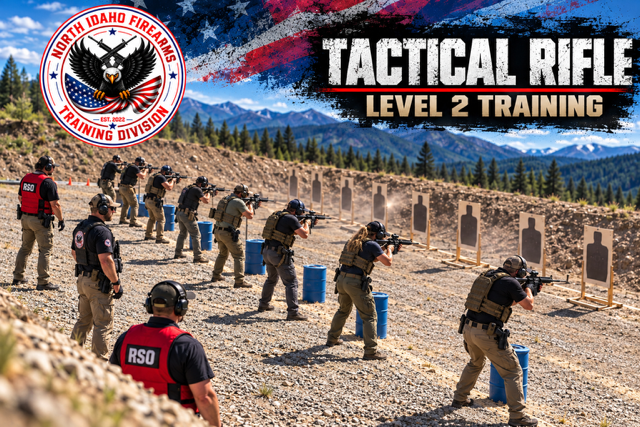
TACTICAL RIFLE LEVEL 2

Course Length: 5–6 Hours
Format: 100% Range / Live Fire
Prerequisite: Tactical Rifle Level 1 or Instructor Approval
Recommended Ammunition: 400–500 Rifle Rounds

COURSE DESCRIPTION

Tactical Rifle Level 2 is an intermediate live-fire course designed to build upon the safety, rifle handling, marksmanship, and manipulation skills developed during Tactical Rifle Level 1.

The course is conducted entirely on the range. Students begin with a safety briefing and confirmation of Level 1 fundamentals before progressing into increasingly challenging live-fire exercises involving rifle manipulation, different shooting positions, multiple distances, use of cover, movement, and equipment management.

The emphasis throughout the course is on safe gun handling, accuracy, consistency, and efficient rifle manipulation.

REQUIRED EQUIPMENT

  • AR-15 or comparable semi-automatic rifle…..
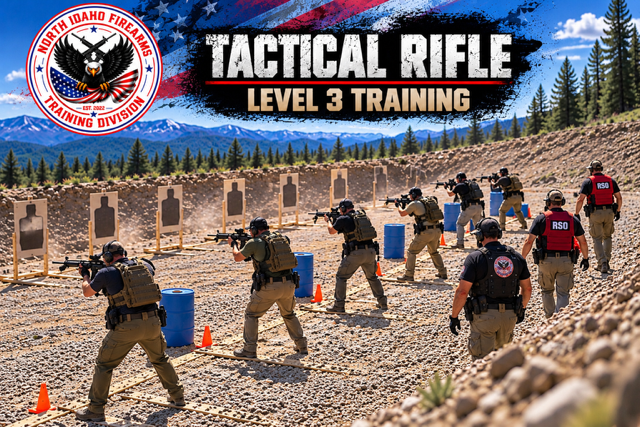
TACTICAL RIFLE LEVEL 3 – ADVANCED

Course Length: 6 Hours
Format: 100% Range / Live Fire
Level: Advanced
Prerequisite: Tactical Rifle Level 2 or Instructor Approval
Recommended Ammunition: 500 Rifle Rounds

COURSE DESCRIPTION

Tactical Rifle Level 3 is an advanced live-fire course that builds directly upon the skills developed in Tactical Rifle Levels 1 and 2.

The course begins with a safety briefing and confirmation of previously learned skills before progressing into more demanding live-fire exercises. Students will combine rifle manipulation, positional shooting, reloads, malfunction clearing, multiple distances, multiple targets, movement, use of cover, and equipment management.

The emphasis is on maintaining safety, accuracy, consistency and sound decision-making while performing increasingly complex shooting exercises….

TACTICAL RIFLE BEGINNER FUNDAMENTALS

Course Length: 6 Hours
Format: Classroom Only – No Live Fire / No Range Time
Experience Level: Beginner
Course Fee: $40 Cash / $45 Card

COURSE DESCRIPTION

The Beginner AR-15 Fundamentals Course is designed for new or inexperienced AR-15 owners who want to develop a solid understanding of their rifle before attending live-fire training.

This six-hour classroom course introduces students to the AR-15 platform with an emphasis on firearm safety, responsible handling, basic operation, equipment selection, shooting fundamentals, range etiquette, and routine maintenance.

Students will use their own unloaded AR-15 during supervised classroom demonstrations and practical exercises. No live ammunition will be permitted in the classroom.

REQUIRED EQUIPMENT

Students should bring:

  • AR-15 rifle, unloaded and secured in a rifle case
    • Rifle sling
    • One empty magazine
    • Rifle optic, if equipped — red-dot optic recommended
    • Iron sights, if equipped
    • Rifle case
    • Owner’s manual, if available
    • Notebook and pen/pencil

NO LIVE AMMUNITION IN THE CLASSROOM.

COURSE OUTLINE

  1. Firearm Safety & Responsible Handling

Introduction to the fundamental rules of firearm safety, safe muzzle direction, trigger-finger discipline, verifying an unloaded firearm, safe classroom handling, transportation and storage considerations.

  1. Understanding the AR-15

Introduction to the AR-15 platform and its major components, including the upper and lower receiver assemblies, barrel, bolt carrier group, charging handle, magazine, stock, handguard and controls.

Students will learn at a beginner level how the AR-15 operates and how its major components work together.

  1. AR-15 Configurations & Barrel Lengths

Discussion of common AR-15 configurations and barrel lengths. Students will learn how different configurations can affect overall size, handling characteristics and intended sporting or recreational uses.

  1. Ammunition & Magazines

Introduction to common AR-15 ammunition and basic cartridge terminology, including discussion of .223 Remington and 5.56×45mm ammunition.

The class will also cover common magazine types, magazine construction, capacity, inspection, maintenance and recognizing damaged or unreliable magazines.

  1. Sights & Optics

Introduction to:

  • Red-dot optics
    • Iron sights
    • Basic sight alignment and sight picture concepts
    • Optic placement
    • Eye position
    • Understanding the concept of zeroing
    • Advantages and limitations of common sighting systems
  1. Sling Setup & Carry

Students will learn the purpose of a rifle sling and common sling configurations, with emphasis on safe administrative carry, muzzle awareness and maintaining positive control of the rifle.

  1. Basic Rifle Fundamentals

Classroom instruction and unloaded-rifle demonstrations covering:

  • Stable shooting stance
    • Rifle placement
    • Support-hand position
    • Firing-hand grip
    • Head and eye position
    • Sight/optic acquisition
    • Target acquisition
    • Trigger control
    • Follow-through concepts
    • Maintaining muzzle control
  1. Range Safety & Etiquette

Students will be introduced to commonly used range procedures and terminology, including:

  • Range Safety Officer responsibilities
    • Following range commands
    • Hot and cold range procedures
    • Safe handling areas
    • Muzzle and trigger-finger discipline
    • Courtesy toward other shooters
    • What to do when a firearm problem occurs
    • Safe arrival and departure from the firing line
  1. Field Stripping & Cleaning

Instructor-guided introduction to basic AR-15 field stripping and reassembly.

Students will identify the major components normally removed during routine maintenance and learn basic inspection, cleaning and lubrication principles.

Students will then practice basic disassembly and reassembly of their own rifle under instructor supervision.

  1. Course Review & Questions

The course concludes with a review of firearm safety, AR-15 operation, equipment, shooting fundamentals, range procedures and maintenance.

Students will have an opportunity to ask questions about their individual rifles, optics, slings and equipment.

COURSE GOAL

Upon completion, students should have a stronger understanding of their AR-15, its basic operation and components, safe firearm-handling practices, common equipment, basic shooting fundamentals, range etiquette, and routine field stripping and maintenance.

This course is intended to establish the classroom foundation necessary for students who may later progress to live-fire AR-15 training.

North Idaho Firearms – Training Division
Tactical Rifle Beginner Fundamentals
6-Hour Classroom Course
$40 Cash / $45 Card

Tactical Rifle Level 1

Course Length: 5 Hours
Format: Range / Live-Fire Training
Ammunition: 350 rounds minimum — .223 Remington / 5.56×45mm

Course Description: AR-15 Level 1 is designed for shooters who understand the basic operation of their rifle and are ready to develop safe, practical live-fire skills. The course begins with a safety and fundamentals review before progressing through rifle handling, ready positions, reloads, malfunction clearing, marksmanship, red-dot zeroing, height over bore, recoil management, shooting at multiple distances, and multiple-round shooting exercises.

Required Equipment

  • AR-15 rifle with sling
  • Red-dot optic
  • 3 spare magazines
  • Rifle case
  • 350 rounds of .223/5.56 ammunition
  • Eye and ear protection
  • Appropriate range clothing
  • Shoes/boots suitable for standing for extended periods
  • Ballcap recommended
  • Snacks and drinks/water
  • Cleaning kit and basic rifle tools

5-Hour Course Structure

Hour 1 — Safety, Fundamentals & Rifle Handling: Range safety briefing, muzzle and trigger-finger discipline, range commands, loading/unloading procedures, stance, grip, sling use, rifle carry positions, high ready and low ready, presentation of the rifle, manipulation of the safety selector, sight alignment/sight picture, and dry-practice manipulation before live fire.

Hour 2 — Marksmanship, Red Dot & Zero: Basic live-fire marksmanship, establishing a consistent shooting position, trigger control, follow-through, recoil management, red-dot fundamentals, confirming/establishing a zero, understanding mechanical offset, and an introduction to Height Over Bore (H.O.B.) and how point of aim and point of impact vary with distance.

Hour 3 — Reloads & Malfunctions: Administrative loading/unloading review, emergency/combat magazine changes, tactical magazine changes, maintaining muzzle awareness during manipulations, recognizing common stoppages and malfunctions, and safe procedures for clearing them. Students then apply these skills during controlled live-fire exercises.

Hour 4 — Multiple Distances & H.O.B.: Live-fire exercises from multiple distances, applying sight offset at closer distances, confirming point-of-aim/point-of-impact relationships, target acquisition, recoil recovery, consistent rifle presentation, and progressively applying fundamentals as distance changes.

Hour 5 — Multiple-Round Evolutions & Skills Evaluation: Controlled multiple-round strings, target acquisition and reacquisition, recoil management, reloads incorporated into shooting exercises, malfunction-response exercises, shooting from different distances, and a final course combining the fundamental skills taught throughout the day.

Major Training Objectives

By the end of Tactical Rifle Level 1, students should be able to safely handle and operate their rifle; use high- and low-ready positions; manipulate the safety without disrupting their firing grip; perform combat/emergency and tactical magazine changes; recognize and safely clear common malfunctions; demonstrate basic marksmanship and recoil management; establish and confirm a red-dot zero; explain H.O.B. and apply appropriate sight offset at different distances; and safely complete controlled multiple-round shooting exercises.

Recommended prerequisite: Tactical Rifle Beginner Fundamentals or equivalent knowledge/experience.

TACTICAL RIFLE LEVEL 2

Course Length: 5–6 Hours
Format: 100% Range / Live Fire
Prerequisite: Tactical Rifle Level 1 or Instructor Approval
Recommended Ammunition: 400–500 Rifle Rounds

COURSE DESCRIPTION

Tactical Rifle Level 2 is an intermediate live-fire course designed to build upon the safety, rifle handling, marksmanship, and manipulation skills developed during Tactical Rifle Level 1.

The course is conducted entirely on the range. Students begin with a safety briefing and confirmation of Level 1 fundamentals before progressing into increasingly challenging live-fire exercises involving rifle manipulation, different shooting positions, multiple distances, use of cover, movement, and equipment management.

The emphasis throughout the course is on safe gun handling, accuracy, consistency, and efficient rifle manipulation.

REQUIRED EQUIPMENT

  • AR-15 or comparable semi-automatic rifle
    • Properly mounted red-dot or approved optic
    • Rifle sling
    • Minimum 3–4 rifle magazines
    • Magazine pouches / appropriate range belt or load-carrying equipment
    • Rifle case
    • Eye and ear protection
    • Appropriate range clothing
    • Sturdy shoes or boots
    • Ballcap recommended
    • 400–500 rounds of appropriate rifle ammunition
    • Cleaning kit / basic rifle tools
    • Water, drinks and snacks

LEVEL 1 SKILLS REVIEW

Students begin by confirming the fundamentals learned during Level 1:

  • Firearm and range safety
    • Stance and grip
    • High and low ready
    • Rifle carry positions
    • Safety-selector manipulation
    • Target acquisition
    • Sight alignment / red-dot use
    • Trigger control
    • Recoil management
    • Height Over Bore (H.O.B.) and offset
    • Combat/emergency and tactical reloads
    • Recognition and clearing of common malfunctions

LEVEL 2 SKILLS

Training progresses into:

  • Faster rifle presentation and target acquisition
    • Shooting from standing, kneeling and prone positions
    • Position changes while maintaining muzzle control
    • Reloads incorporated into live-fire exercises
    • Malfunction clearing during shooting exercises
    • Shooting from multiple distances
    • Applying H.O.B. offset at varying distances
    • Multiple-round strings
    • Multiple-target engagement
    • Introduction to controlled movement with the rifle
    • Shooting from and around cover/barricades
    • Maintaining accuracy while increasing shooting tempo
    • Sling and equipment management during live fire

5–6 HOUR RANGE STRUCTURE

Block 1 – Safety & Level 1 Confirmation
Range briefing, rifle inspection, zero confirmation, fundamentals, ready positions, safety manipulation, basic marksmanship and H.O.B. review.

Block 2 – Rifle Manipulation
Rifle presentation, target acquisition, recoil management, combat/emergency reloads, tactical reloads and malfunction-clearing exercises.

Block 3 – Shooting Positions
Standing, kneeling and prone shooting with controlled transitions between positions.

Block 4 – Multiple Distances & Targets
Live-fire exercises incorporating changing distances, H.O.B. considerations, target transitions and multiple-target exercises.

Block 5 – Movement & Cover
Introduction to controlled movement, maintaining muzzle awareness while changing position, and use of available cover or barricades.

Block 6 – Level 2 Skills Integration
Progressive exercises combining marksmanship, rifle manipulation, position changes, reloads, multiple targets and previously learned Level 2 skills.

COURSE GOAL

Upon completion, students should demonstrate safe and consistent intermediate-level rifle handling while performing increasingly complex live-fire exercises. Students should be capable of applying their Level 1 fundamentals while working from different positions and distances and incorporating reloads, malfunction clearing, movement and use of cover.

Successful completion prepares the student to progress to Tactical Rifle Level 3 – Advanced.

North Idaho Firearms – Training Division

For your course progression, I’d use 400–500 rifle rounds for Level 2. That gives you enough ammunition for a full 5–6 hour range day without requiring every block to become a high-round-count exercise

TACTICAL RIFLE LEVEL 3 – ADVANCED

Course Length: 6 Hours
Format: 100% Range / Live Fire
Level: Advanced
Prerequisite: Tactical Rifle Level 2 or Instructor Approval
Recommended Ammunition: 500 Rifle Rounds

COURSE DESCRIPTION

Tactical Rifle Level 3 is an advanced live-fire course that builds directly upon the skills developed in Tactical Rifle Levels 1 and 2.

The course begins with a safety briefing and confirmation of previously learned skills before progressing into more demanding live-fire exercises. Students will combine rifle manipulation, positional shooting, reloads, malfunction clearing, multiple distances, multiple targets, movement, use of cover, and equipment management.

The emphasis is on maintaining safety, accuracy, consistency and sound decision-making while performing increasingly complex shooting exercises.

REQUIRED EQUIPMENT

  • AR-15 or comparable semi-automatic rifle
    • Properly mounted red-dot or approved optic
    • Rifle sling
    • Minimum 4 rifle magazines
    • Magazine pouches / range belt or load-carrying equipment
    • Rifle case
    • Eye and ear protection
    • Appropriate range clothing
    • Sturdy shoes or boots
    • Ballcap recommended
    • 500 rounds of appropriate rifle ammunition
    • Cleaning kit / basic rifle tools
    • Water, snacks and drinks
    • Knee pads recommended

LEVEL 1 & 2 SKILLS CONFIRMATION

Students will begin by confirming proficiency with previously taught fundamentals:

  • Firearm and range safety
    • Stance and grip
    • High and low ready
    • Safety-selector manipulation
    • Rifle presentation and target acquisition
    • Recoil management
    • Red-dot use and zero confirmation
    • Height Over Bore (H.O.B.)
    • Combat/emergency and tactical reloads
    • Malfunction recognition and clearing
    • Standing, kneeling and prone positions
    • Multiple distances and multiple targets
    • Controlled movement
    • Use of cover and barricades

LEVEL 3 SKILLS

Training progresses into:

  • Advanced rifle manipulation under increased tempo
    • Rapid transitions between shooting positions
    • Multiple-target engagement
    • Target transitions at varying distances
    • Shooting while changing positions
    • Movement into and out of shooting positions
    • Use of cover from multiple positions
    • Unconventional shooting positions when appropriate
    • Reloads incorporated into complex shooting exercises
    • Malfunction clearing incorporated into exercises
    • Strong-side and supported positional work
    • Accuracy under time constraints
    • Multiple-round shooting evolutions
    • Combining movement, cover, reloads and target transitions
    • Equipment and sling management during complex exercises
    • Final integrated skills exercises

6-HOUR RANGE STRUCTURE

Hour 1 – Safety & Skills Confirmation
Range briefing, rifle inspection, zero confirmation and live-fire review of Level 1 and Level 2 fundamentals.

Hour 2 – Advanced Manipulation & Positions
Rifle presentation, reloads, malfunction clearing, recoil management and transitions between standing, kneeling, prone and other appropriate positions.

Hour 3 – Multiple Targets & Distances
Target acquisition and transitions, multiple-round strings, changing engagement distances and applying H.O.B. concepts where applicable.

Hour 4 – Movement & Cover
Controlled movement into shooting positions, use of barricades/cover, position changes and maintaining muzzle awareness throughout the exercise.

Hour 5 – Integrated Live-Fire Evolutions
Exercises combining rifle manipulation, multiple targets, position changes, reloads, malfunction response, movement and use of cover.

Hour 6 – Advanced Skills Evaluation
Progressive live-fire exercises combining previously learned skills. Students are evaluated on safety, accuracy, rifle handling, equipment management and consistent application of course fundamentals.

COURSE GOAL

Upon completion, students should demonstrate safe and consistent advanced rifle handling while integrating the skills developed throughout Tactical Rifle Levels 1–3.

Students should be capable of maintaining safe firearm handling and acceptable accuracy while performing increasingly complex live-fire exercises involving multiple positions, distances, targets, reloads, malfunction response, movement and use of cover.

North Idaho Firearms – Training Division

For the progression you’ve established, 500 rifle rounds fits Level 3 well: Level 1 is fundamentals, Level 2 develops intermediate application, and Level 3 combines those skills into longer, more complex exercises.